
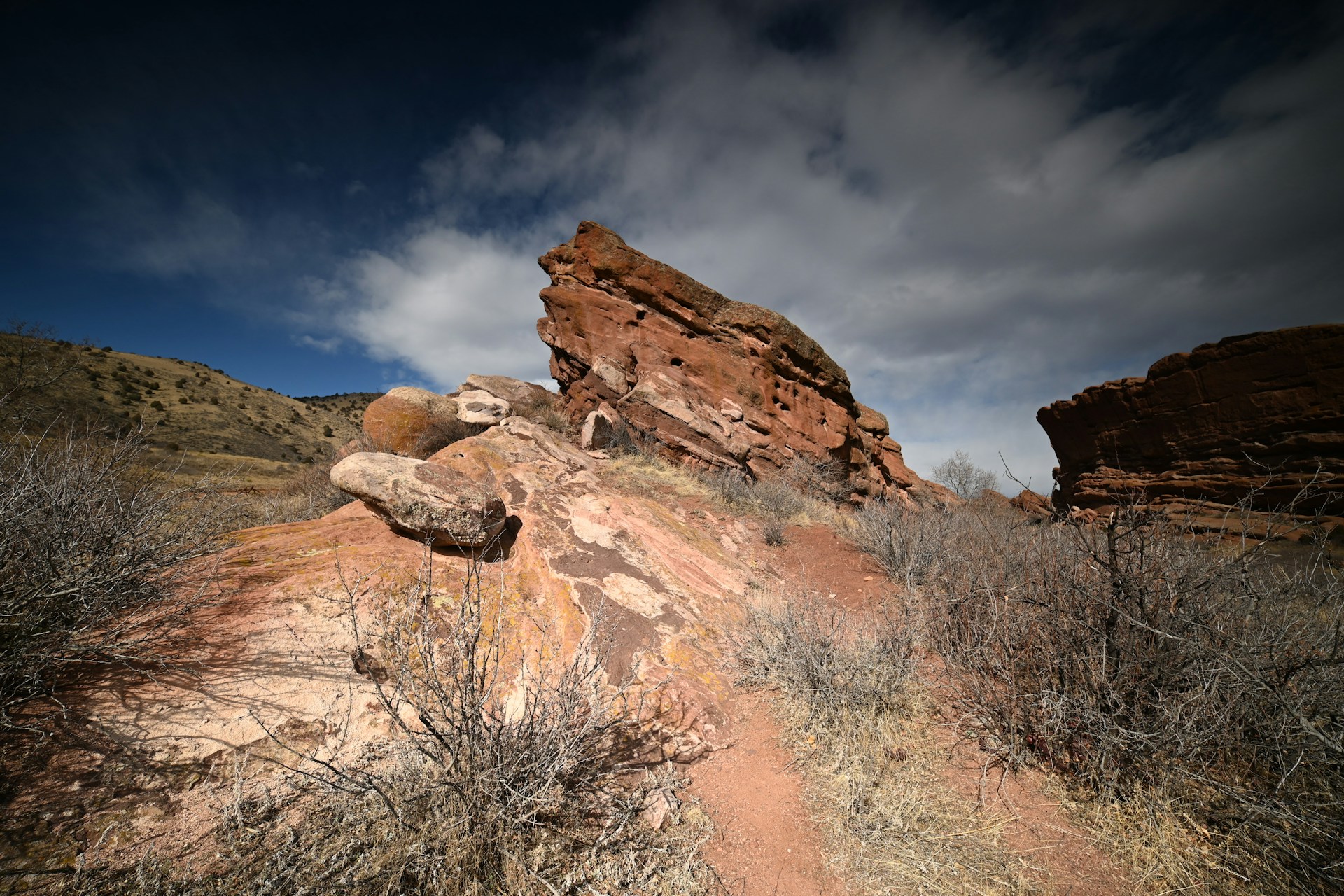
Hidden in Plain Sight: Your Complete Guide to Red Rock Canyon Open Space
Most visitors to Manitou Springs follow the same well-worn trail: they drive past Red Rock Canyon Open Space on Highway 24 without a second glance, bound for the more famous address just a few miles north. That's a mistake. Tucked between Colorado Springs and Manitou Springs, Red Rock Canyon Open Space is 1,474 acres of dramatic sandstone hogbacks, canyon walls, and trail-laced ridgelines — and admission is completely free. No crowds. No parking fees. No shuttle reservations. Just some of the most striking red rock terrain in Colorado, starting less than five minutes from our front door at 229 Manitou Ave.
The park protects the same Fountain Formation sandstone — the ancient river deposit that gives the region its iconic burnt-orange and rust-red color — that you'll recognize from Garden of the Gods. The difference is that here, you're likely to share the trail with more mule deer than tour buses. This guide covers everything you need to make the most of a visit, whether you have two hours or a full day.
What Makes Red Rock Canyon Special
The park sits along a series of parallel red rock ridges, called hogbacks, formed roughly 300 million years ago when ancient rivers deposited thick layers of sediment at the base of an early Rocky Mountain range. Subsequent uplift tilted those layers on edge, creating the steep-walled formations that give the park its drama. Walk along the Sand Canyon Trail on a late afternoon and the light turns the walls amber, then copper, then deep burgundy — a color show that doesn't require a ticket.
Beyond the geology, Red Rock Canyon offers something increasingly rare in the Colorado Front Range: solitude. Even on busy summer weekends, the park absorbs visitors across its eleven trails without feeling overcrowded. The trail network winds through canyon slots, across open mesa, and along ridge crests with views sweeping west to Pikes Peak's snow-capped summit and east across the Colorado Springs grid. Dogs on leash are welcome throughout, and a designated off-leash area near the north parking lot makes this a local favorite for four-legged visitors.
The Outrider Tip
Red Rock Canyon Open Space is a five-minute drive or a short rideshare from our front door on Manitou Ave. We recommend going early — the sandstone catches the morning light beautifully, and the trails are at their quietest before 9am.
The Best Trails
Red Rock Canyon Loop Trail (~3 miles, Moderate)
The park's most popular route combines the best of the hogback terrain with a manageable 3-mile loop and roughly 400 feet of elevation gain. The trail winds along the base of the main sandstone ridgeline, crosses the canyon floor, and loops back via the Mesa Trail with unobstructed Pikes Peak views on the return. This is the route to do if you're short on time and want a complete feel for the park in under two hours.
Contemplative Trail (1.8 miles, Easy)
This is the park's most meditative route — no bikes, no horses, hikers only. The trail was developed specifically to preserve the quiet, introspective quality of the lower canyon, and it shows. Narrow and intimate, it passes beneath towering rock walls through ponderosa pine and scrub oak, with small benches placed at viewpoints along the way. It's the best trail in the park for wildlife: early mornings often produce deer, red fox, and the occasional wild turkey.
Sand Canyon Trail (2.4 miles, Easy-Moderate)
The Sand Canyon cuts deeper into the park's interior, passing through a narrower section of canyon where the walls close in on both sides. The trail floor is sandy in places, the air noticeably cooler in the shaded stretches, and the scale of the rock formations becomes more apparent as you move away from the trailhead. This is a good choice for photographers — the canyon walls create natural leading lines and the late-afternoon light is extraordinary.
Quarry Pass Trail (2.2 miles, Moderate)
One of the park's more historically interesting routes passes through the site of an old sandstone quarry, where blocks of the same Fountain Formation rock were cut for building foundations in early Colorado Springs. The quarry cuts create unusual geometric formations and exposed rock faces that give the trail a character distinct from the natural hogbacks. The trail gains elevation steadily, cresting a ridgeline with panoramic views north toward Garden of the Gods and south toward Cheyenne Mountain.
The Outrider Tip
Combine the Quarry Pass Trail with the Mesa Trail for a full 4-mile loop that hits the park's historical highlights and its best elevated viewpoints. Allow two to three hours and bring a full water bottle — there is no water on trail.
Practical Information
Red Rock Canyon Open Space is managed by the City of Colorado Springs and is free to enter year-round. The main parking lot is located off Ridge Road, south of Highway 24 and west of the I-25 interchange — take the Cimarron/Highway 24 exit and head west for about three miles, then turn left (south) on Ridge Road. A second lot sits slightly further south and is useful when the main lot fills on busy weekends.
The park is open daily from 5am to 11pm between May and October, and 5am to 9pm from November through April. Trails are well-marked with color-coded signs at all major junctions, and free trail maps are available at kiosks in both parking lots. The terrain is mostly hard-packed dirt and rock with some sandy sections — trail shoes or light hiking boots work well, though road shoes will get you through most routes without issue.
The Outrider Tip
If you plan to rock climb, a free permit is required from the City of Colorado Springs Parks department. Technical climbing is allowed on many of the main sandstone faces, and the Fountain Formation offers everything from beginner crack routes to serious multi-pitch lines.
Red Rock Canyon vs. Garden of the Gods
The question comes up often, and the honest answer is: both, but for different reasons. Garden of the Gods offers more dramatic individual rock formations, a world-class visitor center, and a level of scale that's hard to match anywhere in the country. Red Rock Canyon offers genuine solitude, a richer trail network for extended hiking, the same geology at closer range, and an experience that feels like a local discovery rather than a national attraction. They're seven miles apart and an easy split-day: hit Red Rock Canyon early in the morning when the light is best, drive north to Garden of the Gods for the afternoon formations and visitor center, and be back at The Outrider in time for the fire pit.
The Outrider Tip
After a morning in Red Rock Canyon, the post-hike sequence at The Outrider is simple: cold plunge to reset, sauna to warm back up, and the outdoor fire pit to process the views. The park is close enough that you'll be back before the crowds arrive at Garden of the Gods — best of both worlds.